
Searching Park County Criminal Dockets
Start a Park County criminal hearing search with the free Colorado Judicial Branch Docket Search. Pick Park County or Judicial District 11. Then set a date or date range. Add one more filter, since a date alone will not run the query. The second filter can be a party or attorney name, or the case number itself. When you have the number, use its four-digit year, case class, and sequence. Keep in mind the site is a calendar only, not a full case history.
A web calendar is not the whole of a Park County criminal docket. CoCourts sells statewide, non-protected index data, though it does not include the filed documents. For those, turn to the Combined Court clerk. The office provides a Register of Actions, called an ROA. Individual records come via the Record/Document Request form. You can also email parkcountyclerk@judicial.state.co.us, call 719-836-2940, or fax 719-838-4569. Mail works too: P.O. Box 190, Fairplay, CO 80440. Or visit the counter at 300 Fourth Street.
- Read the court name and case class on the notice, summons, or existing record.
- Search the free calendar with Park County, a date, and one more exact filter.
- Check the date, start time, hearing type, appearance type, courtroom, and case number.
- Ask the clerk for the ROA when the full sequence of entries matters.
- Request the signed disposition, sentence order, or other named document separately.
Note: A printable calendar result only shows the schedule. It will not include every filing, charge detail, order, or prior reset in the court docket.
Park County Criminal Case Classes
The letters in a Park County criminal case number tell you where to search. A District Court felony usually carries the CR class. County Court misdemeanors use M, and state traffic matters use T. Build the full number from year, class, and sequence, like 2025 CR 000123. Keep every leading zero. Checking the class beats guessing from the alleged conduct. Park County Court can handle a felony's preliminary stage before the District Court CR file takes over.
- CR
- A felony or other district criminal matter in Park County District Court.
- M
- A misdemeanor matter in Park County Court.
- T
- A state traffic case held by Park County Court.
- ROA
- The clerk-generated Register of Actions, which lists the case history and summary fields.
Municipal ordinance charges do not turn into M or CR matters just because they arose in Park County. Fairplay and Alma run their own ordinance and eligible municipal traffic dockets. Start with the court named on the citation.
Inside a Park County Criminal Docket
A Park County criminal docket result answers a calendar question and nothing more. You get the date, the time, and the courtroom. The entry may also list the case number, hearing type, court location, and estimated duration. It notes whether you appear in person or remotely. For the full story, turn to the ROA. Its ICON layout packs in far more detail: court and county, file status, assignment, next and last events, parties and counsel, agencies, bond or warrant indicators, charges, pleas, dispositions, sentences, costs, and a chronological description of every event. That is the record where a Park County case actually lives.
| Case Number | Year, CR, M, or T class, and sequence identify the court file. |
|---|---|
| Schedule | Next and last scheduled events may show codes, dates, times, and rooms. |
| Charge Block | Each count can list its statute, offense class, plea, disposition, and sentence fields. |
| Bond or Warrant | Indicators and dates provide context, but current status should be verified with the official court channel. |
| Events | Filed date, event description, event ID, e-file flag, and notes form the chronology. |
| Case Status | Open or closed is an administrative state, not a complete statement of the result. |
Need the exact case number? The public Park County case lookup is a good first stop. But only the clerk can hand you an exact, signed order. A docket entry is just an index of what was filed. It points to the act. It is not the signed text itself.
Reading Park County Criminal Charges
A filed charge is only an allegation. It is not a conviction. No matter how it reads on the screen. Take each count on a Park County criminal ROA one at a time. Find the plea and disposition fields attached to that charge. Then look for any sentence entry. A closed flag is not the outcome either. A closed case might hold a dismissal, a plea, a trial result, a sentence, an appeal, or later review. The official Park ICON ROA sample spells out the field layout. The signed disposition or sentence order still controls any real case.
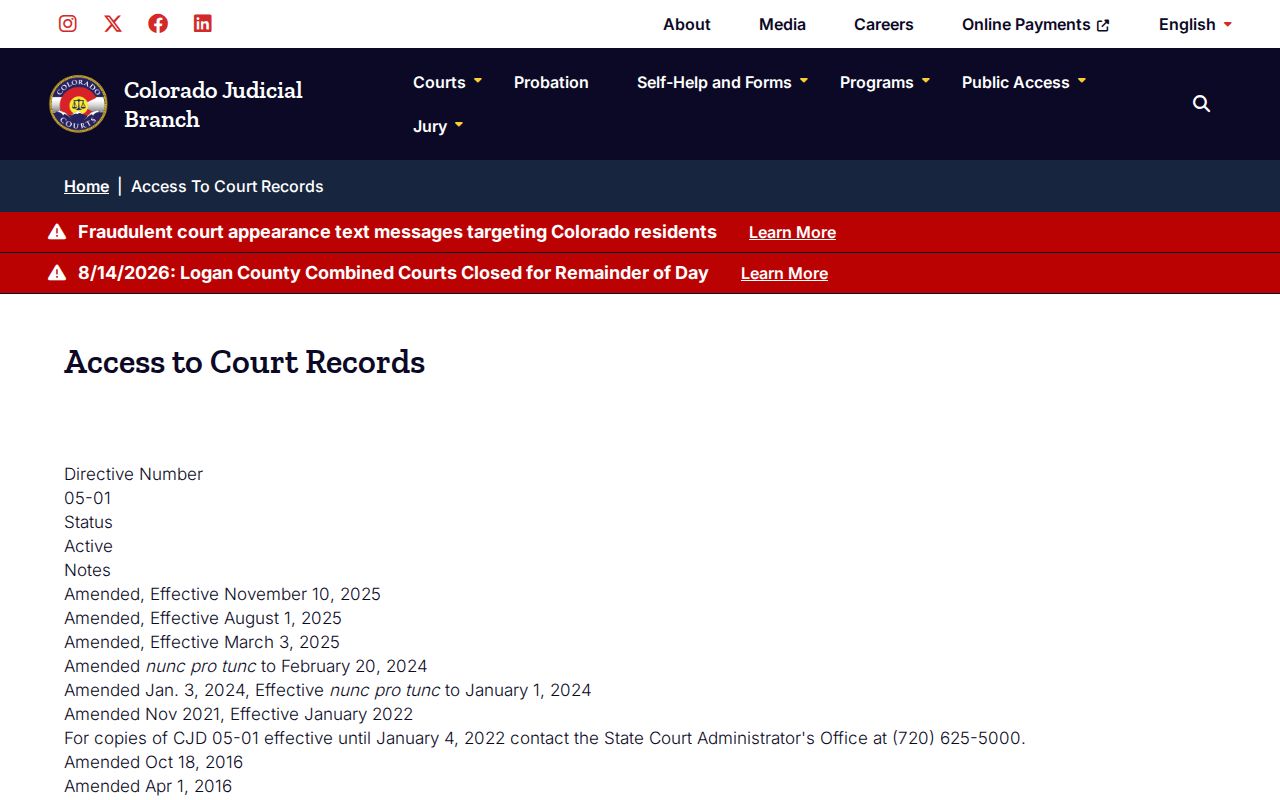
For access rules, the Colorado Judicial Branch page for CJD 05-01 is the official source. It governs who may view what. It does not expose the sensitive personal content that appeared in an older sample ROA.
Here is the key Park County distinction. Public access follows court rules. The criminal ROA stays a structured court record with masked or restricted fields. Access and content are two different things.
Note: Get current bond or warrant status from the court's official channel. An old ROA or a cached calendar result will not do.
How a Criminal Case Moves
A Park County criminal case unfolds in steps. It often starts with a complaint, a warrant, or a summons. Then comes advisement or first appearance, sometimes with a bond event. When the charge or information is filed, the docket moves toward arraignment and a plea. From there, pretrial conferences, status settings, and motion hearings fill the record. They add readiness checks and disputed issues. The case may end by plea or by trial. The docket records what follows: disposition, sentencing, review or probation events, an appeal, and closure.
Docket flow: Filing → Arraignment → Pretrial → Plea or Trial → Disposition → Sentencing
Not every Park County criminal docket hits every stage. A dismissal can cut a case short. A reset may push one setting back and repeat it. Review events can even appear after the docket shows the case closed. So read each entry's date and description on its own terms. Do not force the file into one neat path.
Park County Criminal Court Routing
One building houses two trial courts in Park County. Park County Combined Court serves as the shared facility and administrative office for both. Felony CR files belong to Park County District Court. Misdemeanor M and state traffic T files belong to Park County Court. That court also handles preliminary felony work. Both state courts route their filings through the Clerk of Court at Combined Court. One shared counter does not merge the two courts legally.
| Court | Criminal docket | Custodian |
|---|---|---|
| Park County District Court | Felony CR matters and later felony stages | Combined Court Clerk of Court |
| Park County Court | Misdemeanor M, state traffic T, and preliminary felony work | Combined Court Clerk of Court |
| Fairplay Municipal Court | Fairplay ordinance, local criminal, parking, animal, and eligible traffic matters | Fairplay municipal clerk |
| Alma Municipal Court | Alma ordinance and eligible municipal traffic matters | Alma municipal clerk |
Park County criminal cases do not always live under one number. A transfer, a change of venue, or an appeal can occur. Any of these can hand the file a second number. Colorado's trial courts form the bottom layer. The Court of Appeals and the Supreme Court sit above them. So when the Park County criminal ROA shows a transfer or appeal, write down both numbers. Keep them together.
Courts That Hold Criminal Dockets
Where does a Park County criminal docket actually live? The answer starts with the issuing authority and the court name printed on the paperwork. State charges land in Park County District Court or Park County Court at Combined Court. An ordinance case belongs to Fairplay or Alma Municipal Court instead. Those towns sometimes share a judge, session process, or remote viewing notice. Shared administration never merges their legal dockets.
For a Fairplay ordinance matter, the Fairplay Municipal Court page points to its clerk. The number is 719-836-2622, option 3. Alma handles its ordinance cases through the Alma municipal clerk at 719-836-2712. The Combined Court clerk cannot help there. Those municipal clerks keep their towns' criminal dockets themselves.
State files are different. The official Park County court page carries the current Combined Court location, hours, research email, phone, fax, docket link, and any weather or closure notice. Call ahead about a public-access terminal before you visit. No official Park County source promises one.
Park County Criminal Access Channels
Each access channel answers a different question about Park County criminal records. The free docket search tells you what events are scheduled. CoCourts sells index data that is not protected. For an actual document, use the web request form. It works for an ROA, a disposition or sentence order, a protection order, a ticket, or another named item. The clerk also takes requests other ways. Try phone, email, fax, mail, or the counter. Older or missing files may sit off-site. Retrieval comes at actual cost, so include the approximate year and the complete case number when you can.
Park County Combined Court Clerk
300 Fourth Street
P.O. Box 190
Fairplay, CO 80440
719-836-2940
Fax: 719-838-4569
Email: parkcountyclerk@judicial.state.co.us
Monday through Friday, 8:00 a.m. to 4:30 p.m., except state holidays
Do not send criminal record requests to the elected Park County Clerk and Recorder. That office does not hold the court files. Send an ROA or disposition request straight to the state Judicial Branch clerk listed above.
Sealed Dockets and Public Access
Public access has limits. Not every Park County criminal document is downloadable. A sealed case may drop out of remote results entirely, or it may show only that it exists. Juvenile and dependency records stay out of ordinary remote search. Victim or protected-person fields can be masked inside an otherwise visible file. Before releasing protected material, the clerk may ask for photo identification, proof of relationship, a release of information, or a court order.
Key Rules:
CJD 05-01 governs public access to Colorado court case records, including excluded and restricted categories.
CJD 06-01 governs court-record costs such as retrieval, copies, and research or redaction.
Colorado Children's Code, Title 19 limits access to juvenile and dependency records.
CORA is the wrong tool here. Colorado Open Records Act requests cover government administrative records, while Park County criminal case files answer to Judicial Branch access authority and clerk review.
Missing Park County Criminal Records
A search result that comes up empty does not mean no Park County criminal case exists. Check your spelling first. Then verify the date range, the full sequence, and the CR, M, or T class. Take a moment to confirm whether the matter is municipal or state. That decides which clerk holds the file. Once you find the right clerk, ask. The record may be old, off-site, sealed, suppressed, or blocked by an identification or release requirement.
Hearing dates shift. Compare the newest signed or served notice against the current calendar. Then confirm with the clerk. A prior setting can linger in the ROA after a reset. Only the court grants a continuance; asking for one does not excuse attendance. The docket may be readable while the outcome stays murky. Then order the signed disposition or sentence document. Do not trust the calendar, a closed label, or one isolated charge entry.